
The Orbital Challenge
Opposing Visions of Digital Sovereignty Collide in Space
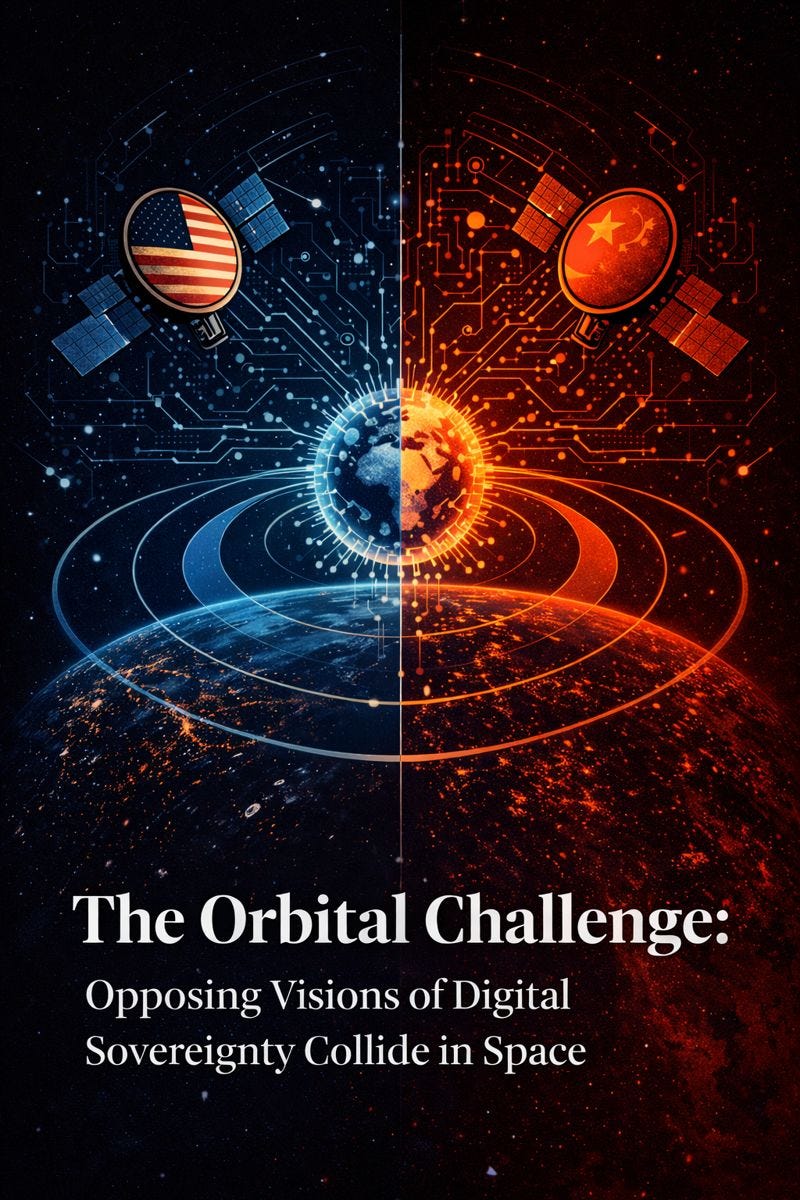
The race to blanket Earth in a mesh of connectivity is not a single story of technological progress, but a clash of two distinct civilizational models playing out in the ultimate high ground: low Earth orbit. On one side is SpaceX’s Starlink, a feat of private ingenuity that has in recent years revealed itself as both a military and geopolitical weapon. On the other is China’s accelerating satellite constellation, a state-driven project openly conceived as the New Digital Silk Road. Their competition exposes a fundamental truth of 21st-century power: control over data flows is sovereignty, and the economics of delivering it dictate the nature of that control.
The Starlink Paradox: The Democratizing Mask of a Premium Weapon
Starlink’s initial promise was seductively modern—a private venture bridging the global digital divide. However, its architecture betrayed a different logic. The “brutal physics” of low Earth orbit render satellites disposable, with lifespans of just 5-7 years before they de-orbit, as discussed here. This creates a perpetual money furnace requiring continuous, staggering investment in manufacturing and launches just to maintain the system. As such, its economics are forever untenable for serving low-margin, rural populations as a primary business.
The system’s sustainable clients were always elsewhere. Its high-bandwidth, low-latency, and global resilience make it an invaluable, premium-tier utility for the most powerful actors: militaries seeking invulnerable command networks, intelligence agencies operating in denied areas, and financial firms where milliseconds mean billions. The incident in Ukraine and Iran—where it became a weapon and tool of influence—were not anomalies but revelations. Starlink is a brilliant, commercially constrained geopolitical weapon, its democratizing narrative the essential cultural cover to claim the orbital commons.
The Chinese Calculus: Sovereignty as Infrastructure
China’s “accelerated run” toward its own mega-constellation operates on a fundamentally different calculus. Where Starlink seeks profitable utility, China is building state-subsidized public infrastructure. Spearheaded by sovereign giants like China Aerospace Science and Technology Corporation (CASC), its goal is not quarterly profit but long-term strategic gain: digital sovereignty, standard-setting, and ecosystem integration.
This model enables a different approach to affordability, one Starlink cannot replicate. First, through subsidized access and bundled diplomacy, China can offer cheap terminals and service as developmental aid or as part of Belt and Road Initiative deals, making connectivity a loss leader for political influence. Second, via industrial ecosystem leverage, the space network can be integrated with China’s terrestrial tech walled garden—bundled with Huawei hardware, Tencent software, and Alibaba cloud services. The sustainability of the orbital segment is cross-subsidized by the value captured in the broader digital economy it feeds.
The High-Stakes Synthesis: Competing Visions of World Order
The collision of these models defines a new frontier of geopolitics.
The Nature of Control: Starlink offers a connection, but one ultimately subject to the policies and commercial interests of a private corporation aligned with U.S. strategic goals. China’s system offers “sovereign internet”—an extension of the Great Firewall into orbit, providing managed, affordable access that reinforces its model of cyber governance.
The Battle for the Global South: This is the core battleground. Starlink’s high marginal cost limits its reach to premium users and ad-hoc interventions. China’s state-backed model is engineered for mass adoption in emerging economies, aiming to shape digital ecosystems, create captive markets for its standards, and foster diplomatic relations through essential infrastructure.
The Ultimate Objective: Both are tools of power. Starlink is an agile, disruptive force extending U.S. technical and ideological influence. China’s constellation is a patient, strategic project designed to ensure it is never a “toll-payer” on a Western-built system. It seeks to construct independent orbital highways, decisively reshaping the architecture of global information flow.
In conclusion, the orbital race is not a simple contest of satellite counts. It is a duel between a commercially-fuelled weapon of influence and a state-built instrument of integrated sovereignty. One leverages market efficiency to serve power; the other wields state capital to build an alternative world order from the ground up—or the sky down. The victor will not only control bandwidth; they will define the very parameters of digital life for billions.
So the Chinese satellites are higher orbit, and don’t burn up so quickly?
Dear Sirs,
I really appreciate very much your articles.
I find quite recently your substack.
Thanks very much for your valuavle work.
May I spread them in my blogs?
Please confirm.
luisa