

Priming the Trap
Five signals suggest the architecture for a financial attack is being quietly assembled. It's not proof, but it is a pattern.

This article is part of an ongoing series of analyses on the war against Iran. Other sections include:
Economic Chemotherapy: America’s Desperate Plan to Save Hegemony
The Strait Logic: Is the War on Iran a Dress Rehearsal for Blockading China?
The Petroyuan Trap: The U.S. Plan to Break China’s Economic Sovereignty
The Blowback Machine: America’s War on Iran and the Ticking Clock
The recent flurry of Chinese financial announcements and the surge in US equity inflows do not prove the petroyuan trap hypothesis. But they are what one would expect to see if it were correct.
In recent weeks, I have written a lot about what I believe is a convergence of inflationary shocks being engineered through the current war in the Gulf and the systematic degradation of global energy supply from Iran to Venezuela and Russia. I have called this the Petroyuan Trap: a multi-stage financial operation designed to exploit structural vulnerabilities in emerging USD-alternative currency architecture—specifically the Chinese yuan. The trap weaponizes a combined fuel/food supply shock timed to for harvest season in the Northern Hemisphere for maximum impact as its trigger and a speculative attack on the offshore yuan as its kill mechanism. In the most recent update I outlined the four financial mechanisms being used to manipulate the global price of energy.
A hypothesis of this nature makes certain predictions, or at least predicts certain patterns we should expect to see. If correct, certain parties should be taking defensive measures, and certain financial flows should be moving in directions consistent with the trap’s imminence. Five recent media stories do not confirm the hypothesis, as proof will remain elusive until undeniable, but a pattern is materializing.
Beijing Fortifies the Currency Architecture
On June 17, Reuters reported a sweeping package of financial reforms from Beijing that was much more ambitious than initial headlines suggested. The centrepiece was the creation of a FIMA RMB Repo Facility—a mechanism allowing foreign central banks, sovereign wealth funds, and international monetary authorities to pledge top-rated Chinese bonds as collateral and borrow renminbi directly from the People’s Bank of China.


This is a significant step toward addressing a vulnerability I identified in the original trap thesis. The absence of a lender-of-last-resort for yuan holders meant that in a crisis, foreign institutions holding renminbi had little choice but to sell them, adding to the offshore selling pressure that a speculative attack would seek to amplify. The FIMA repo facility provides an alternative. It is the infrastructure of a reserve currency being built in real time, and its timing is unlikely to be coincidental.


Alongside the repo facility, Beijing announced that six state-owned banks would begin conducting offshore yuan foreign-exchange transactions within the Shanghai Free Trade Zone, an attempt to bring some of the offshore CNH ecosystem within its regulatory perimeter. A cross-border digital yuan payment system, already signed up by 26 financial institutions, offers a parallel payment rail that bypasses SWIFT. New quotas for institutional investors to move money overseas provide a managed release valve for capital outflows. Taken together, the package represents a carefully calibrated response to the vulnerabilities the trap exploits: liquidity, offshore exposure, payment infrastructure, and capital account management.


The Capital Flight That Isn’t—Or Is It?
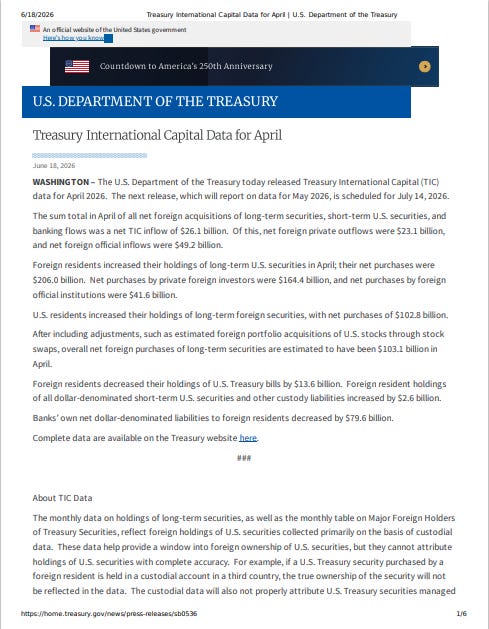
Meanwhile, a quieter but equally significant story has been unfolding in US financial accounts. Foreign investors made record net purchases of US equities—roughly $659bn in 2025 and $884bn over the twelve months through April 2026—the highest on record. According to the TIC data, the bulk of private-sector purchases was recorded through major international financial centres—notably Ireland, Luxembourg, the Cayman Islands and the United Kingdom—jurisdictions that frequently serve as fund domiciles or custodial intermediaries.
The Treasury’s TIC system cannot identify ultimate beneficial owners and only records the counterparty location, not the end investor. So, we cannot know with certainty whether this $884bn ultimately originated from: a Japanese pension fund seeking safety in US assets, a Gulf sovereign wealth fund reallocating from Europe to America, or something else entirely.
The benign interpretation is that this is genuine global risk avoidance. US equities have performed well recently with AI and technology stocks drawing capital from every corner of the world. The wide yield spread between US and European bonds provides more motivation for foreign demand. In a turbulent world, the United States remains the safe haven. That interpretation is plausible but also concerning, because it implies that global investors are positioning for a storm.
The less benign interpretation is that a significant portion of this flow represents US financial institutions’ offshore subsidiaries winding down their overseas portfolios to repatriate capital ahead of a known event. This is what happened in the months before the 2008 financial crisis. US firms brought money home while the radioactive credit default swaps that would trigger the global financial crisis remained buried in foreign balance sheets. The routing through Ireland, Luxembourg, and the Caymans—the classic domiciles for fund wrappers and offshore vehicles as confirmed by Federal Reserve data here and here—is consistent with this pattern. It does not prove it, but it should not be ignored.
The Fourth Signal: The Yuan’s Quiet Appreciation
There is a fourth signal that has received less attention but fits the pattern with uncomfortable precision. Over the past year, the renminbi has appreciated roughly 5 percent against the dollar. This upward drift has continued even as record capital has poured into US equities. So, demand for yuan is rising even as vast sums of dollars are being repatriated to the U.S.


Conventional interpretations of the yuan’s appreciation are relatively benign—or at best positive—and may be right. China’s large trade surplus generates dollar revenues that are converted into yuan, creating genuine upward pressure. The growth of the yuan as a payment system does generate additional demand for the currency as does the growth of yuan denominated financial instruments.
But there is another interpretation. If the current energy market is being manoeuvred to engineer a currency trap, the RMB’s steady appreciation is not a sign of strength. The appreciation may be caused by the quiet accumulation of the ammunition required for the attack.
A short-sell of the yuan—the kill mechanism at the heart of the trap—cannot be improvised at the moment of crisis. It must be prepared. The attacker must borrow or accumulate a substantial pool of offshore yuan in advance, ideally when the currency is strengthening and such accumulation appears benign. The same offshore financial centres that route record US equity inflows through Ireland, Luxembourg, and the Cayman Islands could also be warehousing yuan reserves, quietly building the position that will be unleashed when the energy price spike provides the trigger. The TIC data cannot distinguish a genuine reserve diversification trade from a pre-positioning for a speculative attack. It identifies the transacting jurisdiction, not the ultimate beneficiary. Essentially, we can see what is moving, but not who’s moving it or why.


An appreciating yuan also empowers the trap. It validates Beijing’s narrative that the renminbi is a credible international currency, encouraging oil exporters like Saudi Arabia to accept more yuan in settlement. It discourages Chinese importers from hedging aggressively against a future depreciation, because the recent trend has been favourable. It makes speculative short positions against the yuan expensive to maintain, thinning out the traders who might otherwise provide an early warning. It draws in speculative traders who will be quick to dump it when the wind changes. And it conditions the market to view the yuan as stable, so that when the attack begins, it catches investors, policymakers, and the PBOC itself leaning the wrong way.
Circumstantial factors support this reading. The rapid growth of offshore yuan deposits in Hong Kong and London provides the physical pool that could be drawn upon. The precedent of Treasury Secretary Bessant’s career—accumulating positions quietly before striking at the pound in 1992 and the yen in 2013—demonstrates an institutional familiarity with precisely this kind of pre-positioning. And the Iranian rial collapse in late 2025, which could be viewed as a trial run, involved a similar pattern of quiet reserve accumulation before the currency came under attack.
If this interpretation is correct, the upward pressure on the generated by the stockpiling of yuan reserves is the loading of the weapon. The quiet accumulation is the preparation. The appreciation is the bait. Every month that the yuan strengthens, the offshore pool of renminbi expands—some of it held by genuine reserve diversifiers, and some of it, perhaps, held by those who intend to sell. The only remaining question is when the trigger is pulled.
The Fifth Signal: Merz Invokes the Plaza Accord
On June 19, speaking in Brussels after a European Council summit, German Chancellor Friedrich Merz delivered his most forceful remarks on Beijing since taking office. The Chinese currency, he said, was undervalued by 30 percent—well above the International Monetary Fund’s estimate of about 16 percent. China was “flooding markets” through “high subsidies,” and “subsidising overcapacities” alongside a “currency that isn’t convertible freely” was “not acceptable.”

Then Merz named the precedent explicitly. The Plaza Accord—the 1985 agreement that coordinated the appreciation of the Japanese yen and the German Deutsche Mark against the dollar, ultimately triggering Japan’s asset bubble and three lost decades—was, he suggested, the model for how such matters should be addressed. In my initial article on the Petroyuan Trap on April 26th I explicitly compared the trap to the Plaza Accord.
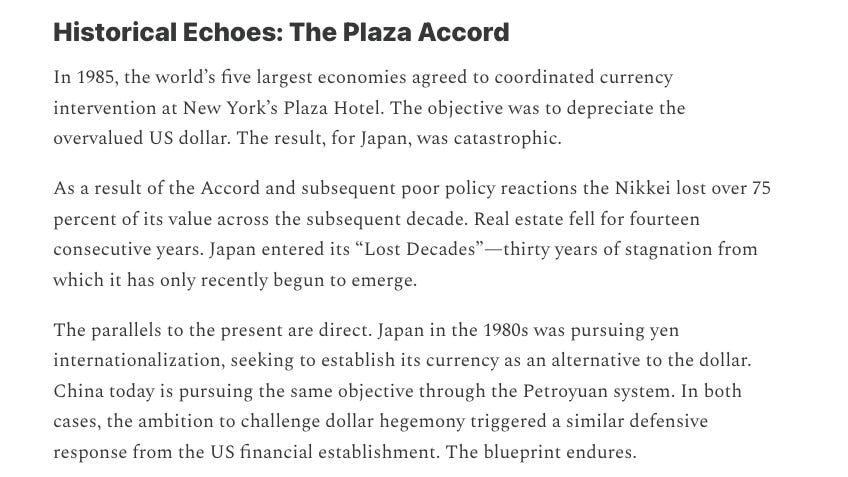
Within the petroyuan trap hypothesis, this is the fifth signal. It does not prove the trap exists. But it is exactly the sort of political flanking manoeuvre one would expect if a coordinated currency realignment were being prepared. The original Plaza Accord was not merely a technical adjustment of exchange rates. It was a geopolitical operation, conducted under U.S. leadership, designed to discipline rising economic rivals whose export competitiveness threatened American industrial primacy. Japan was the primary target. Germany was the junior partner.
Merz’s invocation of that precedent, in the current context, is remarkable. A German chancellor is publicly calling for a coordinated international effort to force the appreciation of the yuan, at a moment when the offshore yuan pool is expanding, when Beijing is racing to build reserve currency infrastructure, and when the energy market analysts are warning that price discovery is being suppressed The political conditions for the currency ambush—the isolation of the target, the construction of a multilateral coalition, the provision of a legitimating narrative—are being assembled alongside the financial ones.
A Pattern, Not Proof
The signal does not confirm the hypothesis. But it adds to the pattern. Beijing is fortifying its currency architecture. The bunker doors are closing on offshore debt. Capital is flowing into the United States at record levels. The yuan is quietly appreciating, providing cover for accumulation. And now the leader of Europe’s largest economy is publicly calling for a Plaza Accord on the renminbi. The pieces are accumulating. The direction is consistent. The question, as ever, is when the trigger is pulled.
The writer is the author of the Petroyuan Trap hypothesis, which examines the structural vulnerabilities created by China’s incomplete reserve currency architecture particularly in the context of violent energy market price correction.
This article is part of an ongoing series of analyses on the war against Iran. Other sections include:
Economic Chemotherapy: America’s Desperate Plan to Save Hegemony
The Strait Logic: Is the War on Iran a Dress Rehearsal for Blockading China?
The Petroyuan Trap: The U.S. Plan to Break China’s Economic Sovereignty
The Blowback Machine: America’s War on Iran and the Ticking Clock
Sources:
“China makes new push to take yuan global, vows vigilance against financial risks,” Reuters, June 17, 2026 https://www.reuters.com/world/asia-pacific/chinas-financial-regulator-vows-risk-prevention-support-strategic-industries-2026-06-17/ ;
“China signs up 26 financial institutions to digital yuan cross-border payment system,” Reuters, June 16, 2026 https://www.reuters.com/world/asia-pacific/china-signs-up-26-financial-institutions-digital-yuan-cross-border-payment-2026-06-16/ ;
“China central bank’s deepening control on short-term rates sparks debate over policy focus,” Reuters, June 17, 2026; https://www.reuters.com/world/asia-pacific/china-central-banks-deepening-control-short-term-rates-sparks-debate-over-policy-2026-06-17/
“China Clamps Down on Issuance of Higher-Yielding Offshore Debt,” Bloomberg, June 2026; US Treasury TIC data, April 2026; BEA International Investment Position, Q1 2026. https://www.bloomberg.com/news/articles/2026-06-30/china-clamps-down-on-issuance-of-higher-yielding-offshore-debt
“Yuan expected to rise in 2026, but Beijing has its reasons for saying not so fast” Reuters, February 4th, 2026. https://www.reuters.com/business/finance/yuan-expected-rise-2026-beijing-has-its-reasons-saying-not-so-fast-2026-02-03/
Additional notes:
The TIC surge is real. Private buying dominates, but official buying is not zero. For equities specifically, official net purchases were $56.1bn in 2025 and $120.9bn over the 12 months through April 2026. The offshore-routing point is well supported. https://fraser.stlouisfed.org/docs/publications/treaspr/2026/2026-06-18_sb0536.pdf
BEA data does not falsify the flow story. https://www.bea.gov/news/2026/us-international-transactions-and-investment-position-1st-quarter-2026-and-annual-update
SHL holdings confirm a real rise in foreign U.S. equity claims. https://home.treasury.gov/news/press-releases/sb0482
The Fed’s CSLT note specifically names the UK, Ireland, Luxembourg, Cayman Islands and others as major financial/custodial centers whose rise reflects globalized intermediation. https://www.federalreserve.gov/econres/notes/feds-notes/the-cslt-unifying-u-s-cross-border-securities-holdings-and-transactions-data-20260521.html
Additional sources:
Thank you, Ryan, excellent work! As you mention about Bessent, as per his “economic statecraft” against Iran, the world’s hegemonic bully is perpetually devising new schemes to undermine any “adversary” - meaning any nation not willing to be a vassal. Even if you had a full treaty ending a kinetic war with the U.S., they would still be hard at it on every conceivable front still in attack mode. No amount of defeat is enough to cause a learning experience with those people, that’s just who they are.
Yes, in building an alternative currency, a lender of last resort is advantageous, as is filling the pool before people can swim (dispersed liquidity) and various swap mechanisms. The usual means of filling the pool is by trade deficit or foreign aid at scale. The flip side of that is funds returning by investment - capturing the savings of the world. China could, however, operate on a forward cash basis which doesn’t need foreign investment along with the drag on the economy of paying interest on foreign debt.
I would guess that China, being a productive economy while the U.S. is an entitlements economy, could weather this storm. The U.S. can’t understand the limits of its power; in fact, they firmly believe there to be no limits to their power. So they go headstrong into another round of war against Iran while being short of munitions. In grabbing for the petroyuan lever, they may be grabbing the wrong end of the stick, which, if the world is lucky, China can use to knock the wobbly legs out of the U.S. financial scheme. That, however, endangers the entire world financial system with all those central banks ending up holding worthless U.S. T-bills.
A mad scheme to break China would mirror the failed “regime change” in Iran - if China is taken out, who could replace that manufacturing? Nobody. If China could knee-cap the U.S. Dollar, there would be a global depression, but in the long run, to everyone’s benefit.
This is indeed disconcerting. How the different monetary/financial infrastructure b/w China now and Japan then would affect the ramification of this (potential) scheme is what I'd like to know first.